The archives
An index of everything we are collecting.
Every clipping, interview, film, story, and photograph we collect will be indexed here.
Movies
Hidden Gems of Norcal: The Willows Airport and Nancy’s Cafe
A short film on the history of Willows and its airport, with photos from the Willows Museum, and a stop at Nancy’s Airport Cafe.
News clippings
Air show coverage from the 1930s. These are also summarized on the Airport page. The scans are from Newspapers.com.
- November 3, 1931
- Advertisement: Willows air show
A full ad for the Armistice Day air show on Wednesday, November 11, put on by the Willows American Legion Post and the Achaean Club as a benefit for airport improvements. Stunt flying, dead-stick landings, parachute jumps, and passenger flights all day, with an Aviators Ball the night before.
Open the clipping (PDF) - November 9, 1931
- “Large Crowd Is Expected at Glenn Air Fete”
Willows prepares for about 2,500 visitors and 25 planes. Headliners are John A. Macready and Emory Bronte, with parachute jumping, trophy races, and new aircraft on display. Proceeds go to improving the airport.
Open the clipping (PDF) - September 11, 1933
- “Willows Holds Airport Fiesta”
The airport is officially dedicated with exercises and an air show, followed by an aviation ball attended by 350 couples. Stamp collectors across the country request envelopes carrying a special Willows airport cachet.
Open the clipping (PDF) - September 25, 1937
- “Willows to Open Aviation Fete”
Three Willows women fly to San Francisco in a plane piloted by F. H. “Speed” Nolta to invite the mayor to the Seventh Annual Northern California Air Show.
Open the clipping (PDF) - September 24, 1938
- “Eighth Annual Airshow in Glenn County Is Under Way”
Opening day of the Eighth Annual Northern California Airshow, with a photo of its organizers, including airport superintendent F. H. Nolta. Parachute jumps, upside-down flying, air races, and a fireworks finale.
Open the clipping (PDF)
Documents
- January 12, 1961
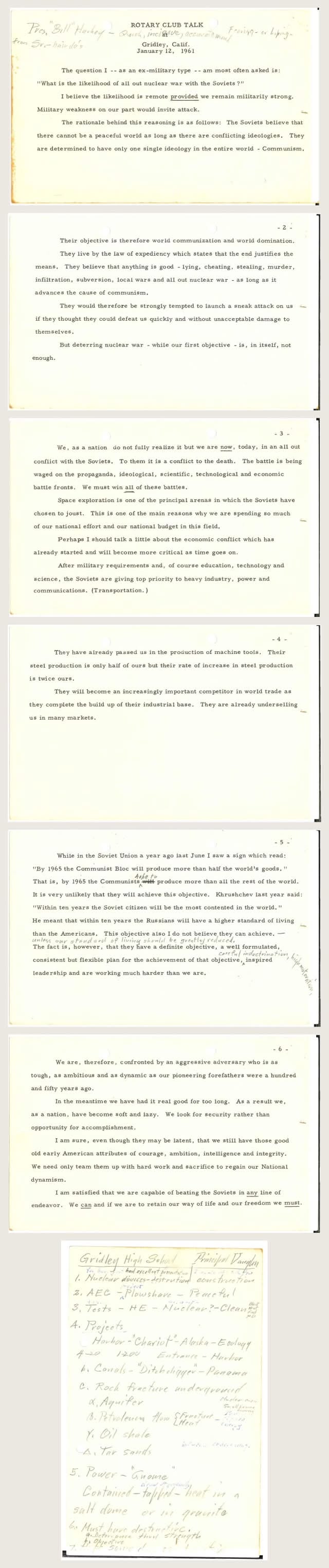
- General Doolittle’s “Rotary Club Talk,” Gridley, Calif.
A speech given by General Jimmy Doolittle to the Rotary Club in Gridley, a few miles from Willows. The six typed pages, about the Cold War and the Soviet Union, carry handwritten notes, and there is a handwritten page headed “Gridley High School.”
Open the scan (JPG)
Pictures
Photographs shown on this page are used with permission. The rest are shown at their source. Most of the Nolta family photographs come from the collection shared on the Early Aviators website by George Nolta.
The Nolta family and Willows Flying Service
- 1927
- The three Nolta brothers
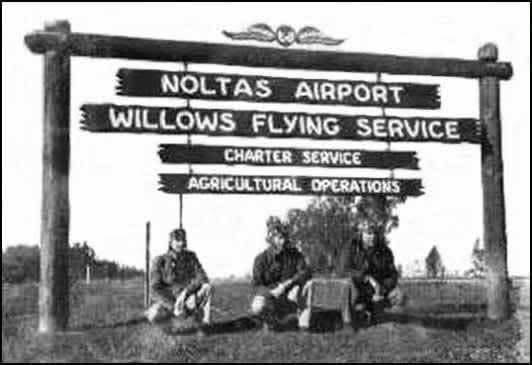
Vance, Dale, and Floyd Nolta, left to right, at the sign outside Nolta’s Flying Service airport north of Willows, near the Blue Gum Lodge.
View at the source - 1929
- Willows Flying Service
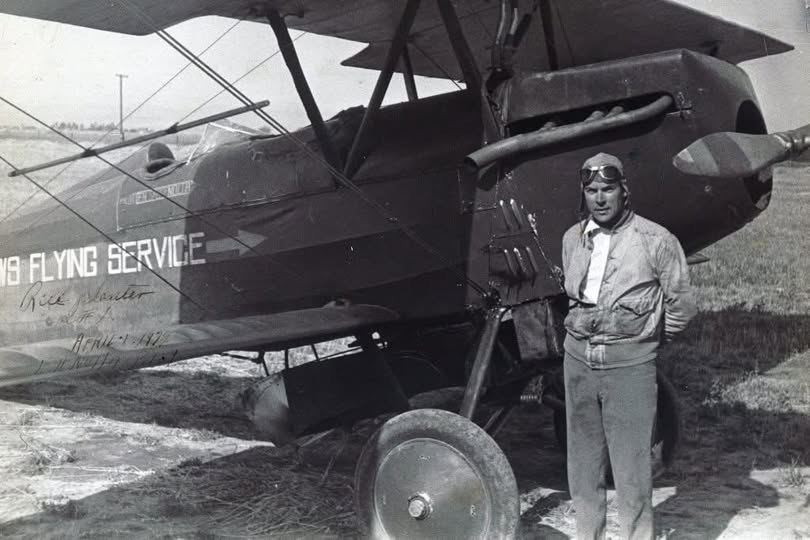
The Hisso Travel Air converted to a rice seeder. Handwriting on the fuselage reads “Rice planter” and a date of April 1.
View at the source - Undated
- Nolta Airport
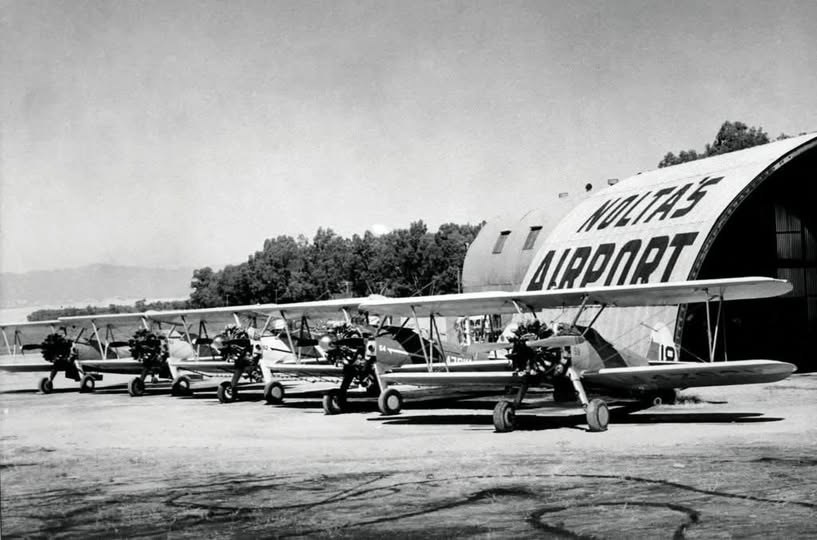
Stearman biplanes likely used for rice sowing and crop dusting.
View at the source - Undated
- Willows Flying Service advertisement
The Piper Cub “75” Cruiser as “America’s Latest Training Plane,” with a complete solo course for as low as $60.
View at the source - Undated
- Floyd Nolta, portrait
A portrait of Floyd “Speed” Nolta.
View at the source - Army years
- Lt. Floyd Nolta
Floyd Nolta in the Army Air Corps.
View at the source - Undated
- Vance Nolta
Floyd’s youngest brother, a mechanic and pilot for the flying service.
View at the source - Undated
- Nolta brothers and their children
Floyd, Dale, Walter with his son Guy, and Dale’s son Edward.
View at the source - Undated
- Early rice planter
One of Floyd Nolta’s early rice-seeding airplanes, with a woman believed to be his wife, Jesse Nolta. The photo album page also has Floyd with one of his early planes, a 1935 Travel Air Speedwing, a Security Airster he owned from 1935 to 1938, and Floyd in his “Trainer.”
View at the source
Fly-in memorabilia
- September 19–20, 1936
- Sixth Annual Northern California Air Show
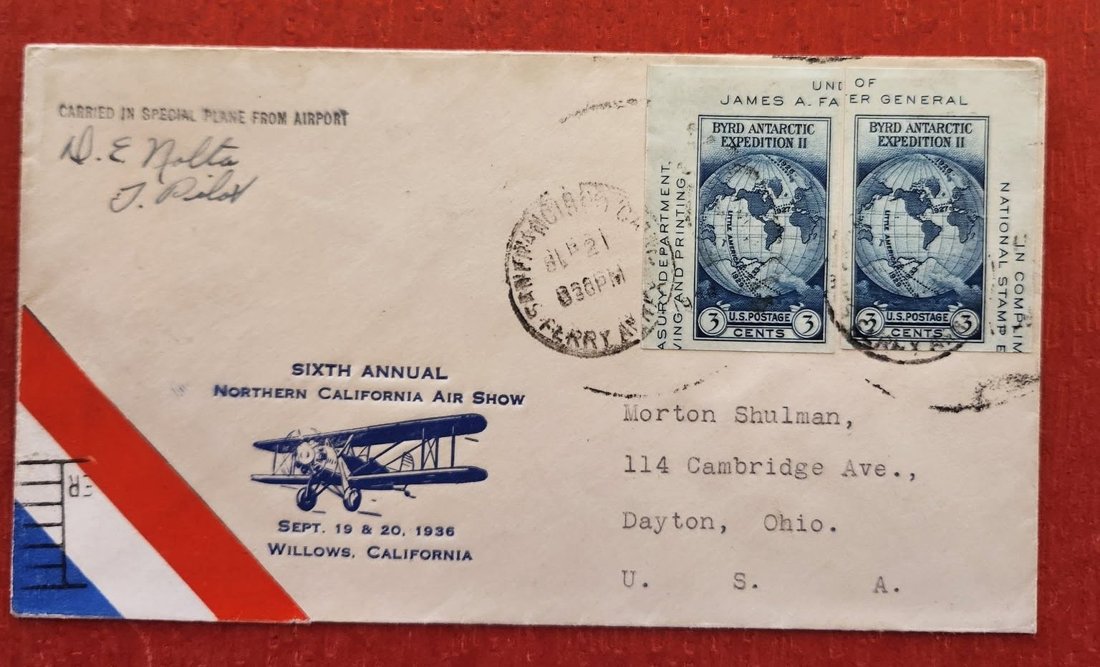
A souvenir air mail cover from the 1936 air show. It is stamped “Carried in special plane from airport” and signed “D. E. Nolta, Pilot” (the initials point to Dale Nolta), and it carries two 3-cent Byrd Antarctic Expedition II stamps. It was postmarked in San Francisco and addressed to Morton Shulman in Dayton, Ohio. - September 12, 1981
- The fourth annual Willows Fly-In
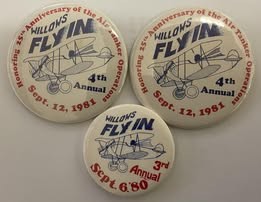
Buttons from the fourth annual Willows Fly-In, held September 12, 1981, which honored the 25th anniversary of air tanker operations. The smaller button is from the third annual fly-in, September 6, 1980.
Talks and presentations
- October 24, 2026
- The Remarkable History of the Willows-Glenn County Airport
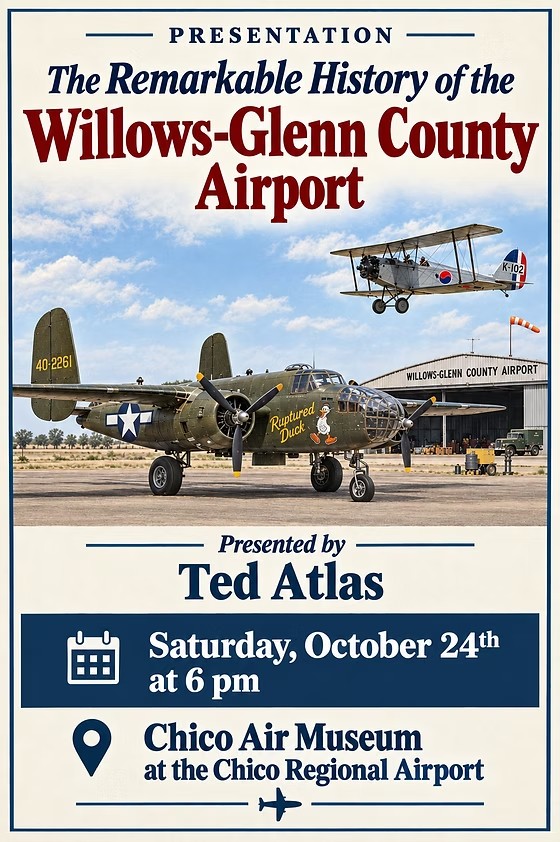
A history talk on KWLW presented by Ted Atlas of San Jose at the Chico Air Museum, at the Chico Regional Airport, on Saturday, October 24, 2026, at 6 pm.
Jimmy Doolittle and the Noltas
- After World War II
- Doolittle and Floyd Nolta
A hunting group in Willows, with Floyd Nolta, Doolittle, and Dale Nolta among them.
View at the source - Undated
- Hunting trip to Willows
Bill Downs, Dale Nolta, General Doolittle, and Hugh Logan, a rancher west of Willows.
View at the source - 1945
- General Doolittle in Willows
Doolittle with Bill Downs, Dale Nolta, and Dale’s children Edward and Joyce.
View at the source - 1948
- General Doolittle and the hosts’ wives
Gretchen Nolta, Jessie Nolta, and General Doolittle.
View at the source
The Doolittle Raiders and Lt. Miller
- 1942
- Official crew photographs
Portraits of the Raider crews, each with its aircraft and target. The museum’s fact sheet covers the crews, and these crew photo pages are linked directly.
Crew fact sheet · Crew 3 · Crew 7 · Crew 10 · Crew 13 · Crew 16 - 1942
- Crew photos and raid images, crews 1 to 16
A gallery with a photograph of each of the 16 crews, plus images of the raid, including Crew 8’s B-25 in the Soviet Union.
View the gallery - About March 1942
- Raider training at Eglin Field
One of the Raiders during carrier takeoff training at Eglin Field, Florida, with a gallery of more training photographs.
View the photos - Undated
- Lt. Henry L. Miller
The Navy flight instructor who taught the Raiders carrier takeoffs and took crews to Willows. A photograph of Miller appears in the National Naval Aviation Museum’s article “Training the Doolittle Raiders.”
View at the museum - Later in life
- Rear Adm. Henry L. Miller, USN (Ret.)
A portrait of Miller on the U.S. Naval Institute page for his oral history, the source of his 1971 recollection of taking crews to Willows.
View the portrait
The raid and its airplanes
- April 1942
- Doolittle and Captain Mitscher with Raiders on the Hornet
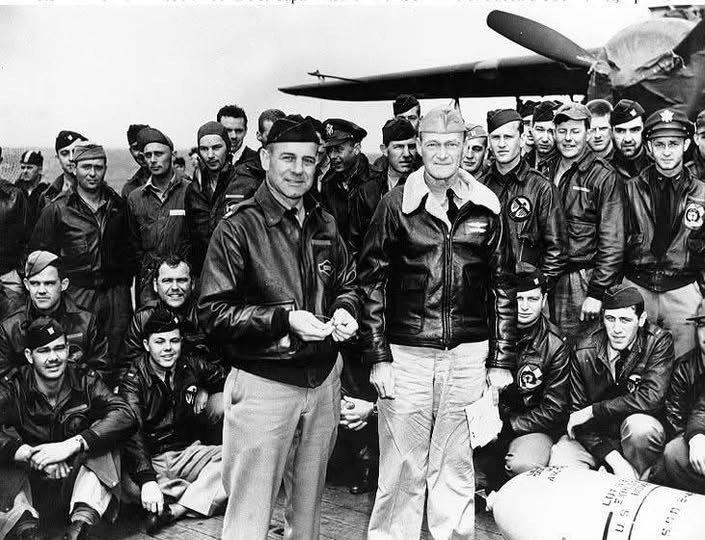
Lt. Col. Jimmy Doolittle, left, and Capt. Marc Mitscher, the Hornet’s commander, stand with Raiders on the carrier’s flight deck. A bomb rests in the foreground. - 1942
- The USS Hornet
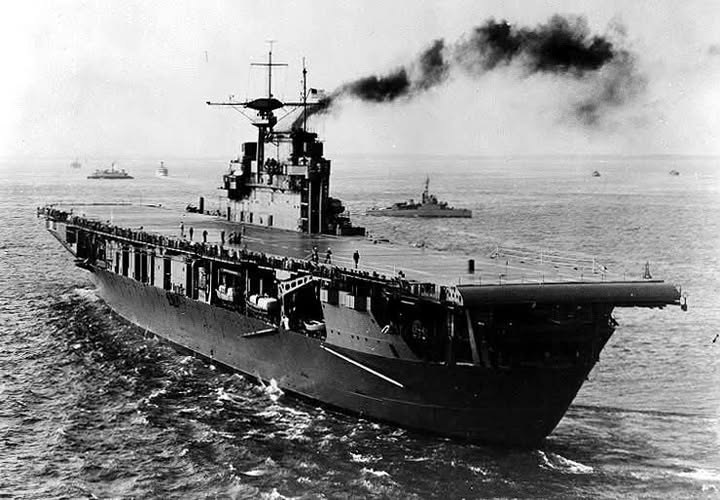
The aircraft carrier USS Hornet (CV-8), underway. On April 18, 1942, the Raiders’ 16 B-25s took off from her deck. - Undated
- A B-25 in flight
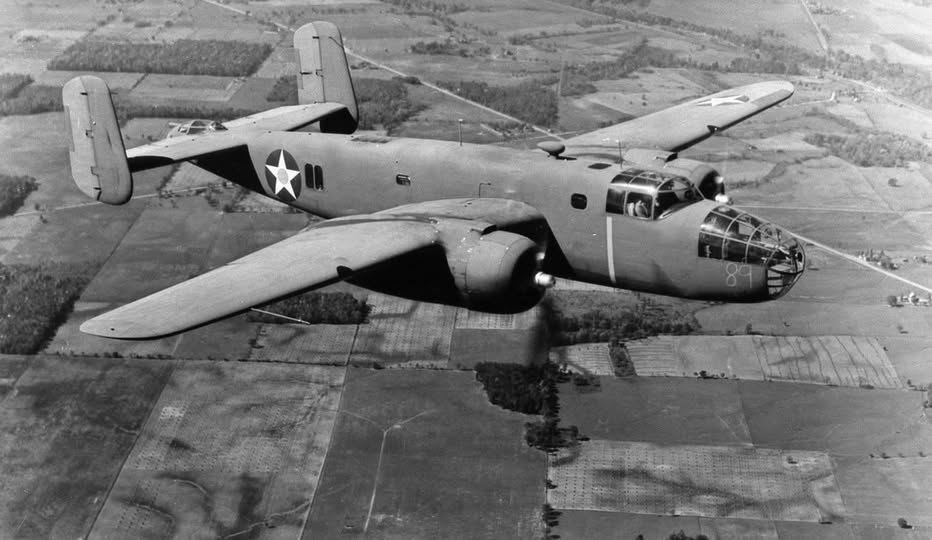
A B-25 Mitchell bomber over farmland. The Raiders flew B-25Bs, the first model of the Mitchell. - Early 1942
- A B-25B at Eglin Field
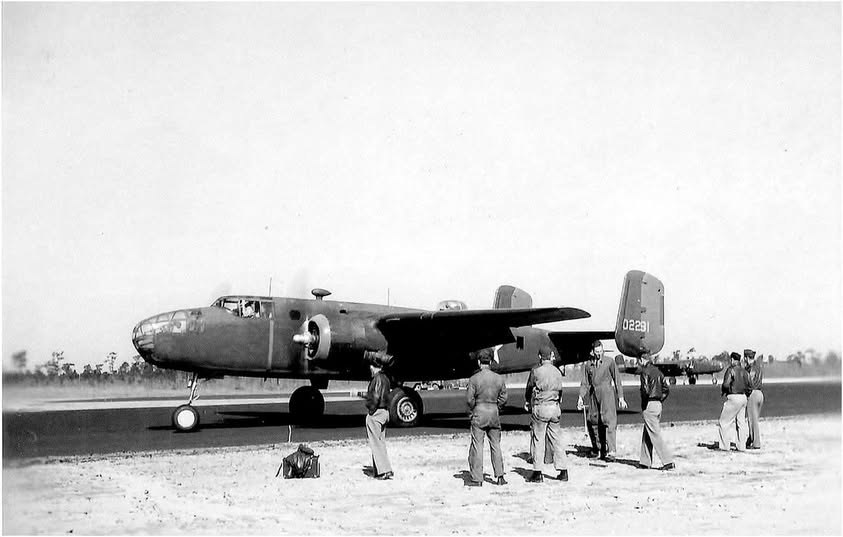
A North American B-25B Mitchell medium bomber during short-field takeoff training at Eglin Field, Florida, in early 1942, in preparation for the Doolittle Raid. The B-25B can be recognized by its dorsal turret, twin tail fins, and transparent nose. The tail number reads 02291. The crews trained for about three weeks under Navy Lt. Henry L. Miller, taking off in a space as short as a 450-foot carrier deck, before the April 18, 1942 strike on Tokyo.
Countdown to the Doolittle Raid (HistoryNet) · The Doolittle Raid (AZCAF) · Eglin Airfield (Vintage Aviation News) - 1942
- Crew 16 after their capture
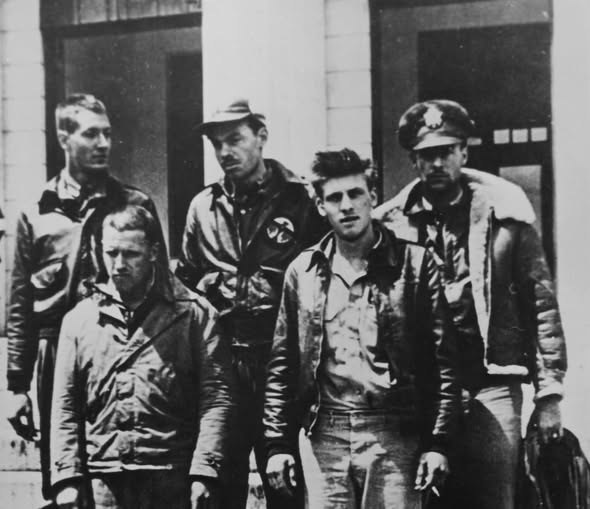
Crew 16 of the Doolittle Raid, who flew the B-25 Bat Out of Hell, photographed after Japanese forces captured them near Nanchang, China, on April 20, 1942. Back row, left to right: Lt. William G. Farrow, pilot, executed by the Japanese on October 15, 1942; Lt. George Barr, navigator, a prisoner of war for more than three years, liberated in August 1945; and Lt. Robert L. Hite, copilot, a prisoner of war until August 1945. Front row, left to right: Cpl. Jacob DeShazer, bombardier, who endured brutal captivity and later returned to Japan as a missionary; and Sgt. Harold A. Spatz, engineer and gunner, executed by the Japanese on October 15, 1942.
Lt. George Barr (doolittle-raid.net) · Doolittle Raid (stewross.com) - Undated
- Jimmy Doolittle in a cockpit
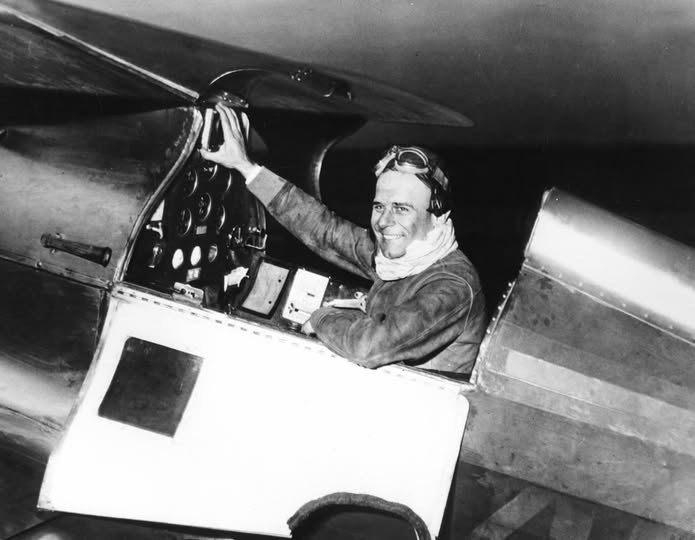
Doolittle in an airplane cockpit, wearing flying goggles and a scarf.
The Korean aviation school
- 1920
- Korean student pilots, Willows
A photograph of the Korean student pilots at Willows.
View the photo - 1920
- Advertisement for the school
A period advertisement for the Willows Korean Aviation School.
View on Wikipedia - Undated
- Park Hee-sung
A portrait of one of the school’s cadets, later an army pilot of the Korean Provisional Government.
View the portrait - Today
- Willows pilots memorial
A memorial at the National Aviation Museum in Korea that honors the pilots trained at the Willows school.
View on Wikipedia

The Willows Daily Journal, 1920
Seven articles from the Willows Daily Journal about the school are cataloged on Calisphere, from the Korean American Digital Archive at the University of Southern California.
- February 19: “Koreans to Have Aviation Field”
- February 26: “Van Bernard Sees Menace in Korean Flying School”
- March 1: “Koreans to Train Aviators Here to Fight the Japs”
- June 22: “Airplane for Korean School Arrives Today”
- June 24: “2nd Airplane for Korean School Arrives Today”
- September 4: “Korean Aviation School to be Seen in the Movies”
- September 14: “Korean Struck by Propeller”
View the articles on Calisphere
The first air tanker and the Bird Dog
- 1955
- Water drop tests
An ag biplane used in water drop tests developed by Willows Flying Service.
View at the source - 1955
- The tanker’s water outlet
The outlet on the first air tanker prototype.
View at the source - 1955
- N75081, the first production tanker
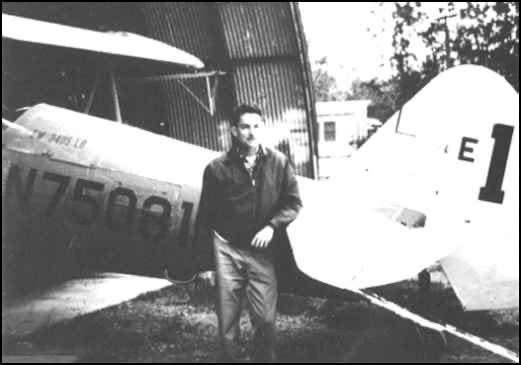
The Boeing Stearman 75 with Vance Nolta, its primary pilot.
View at the source - 1955
- First Airtanker, Mendocino
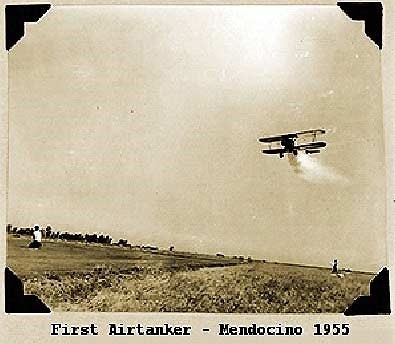
The modified Stearman, N75081, making a drop. The photo is captioned “First Airtanker – Mendocino 1955.”
NWCG: First Airtanker Drop, August 12, 1955 · Historical Marker Database - 1956
- The original pilots at Lake Elsinore
Figure 12 in the airport’s National Register nomination, which identifies the pilots in front of their aircraft. See The firefighters for the names.
View at the source - 1981
- The Birth of the Airtanker Program plaque
The plaque at the Willows airport honoring the first air tanker program.
View at the source - August 1956
- The Piper Tri-Pacer
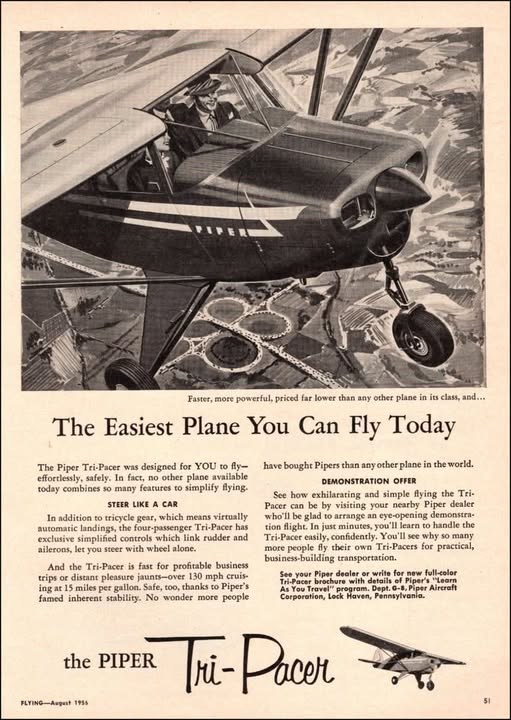
A Piper advertisement from Flying magazine, “The Easiest Plane You Can Fly Today.” The Tri-Pacer is the airplane Lee Sherwood flew as the Bird Dog, directing the tankers. It is shown here as a type, not a photograph of his airplane. - 1956
- Ray Varney readies an N3N
Pilot Ray Varney, with two unidentified loaders, preparing for a flight in a Navy N3N biplane tanker.
View the photo - 1981
- The Birth of the Air Tanker Program marker
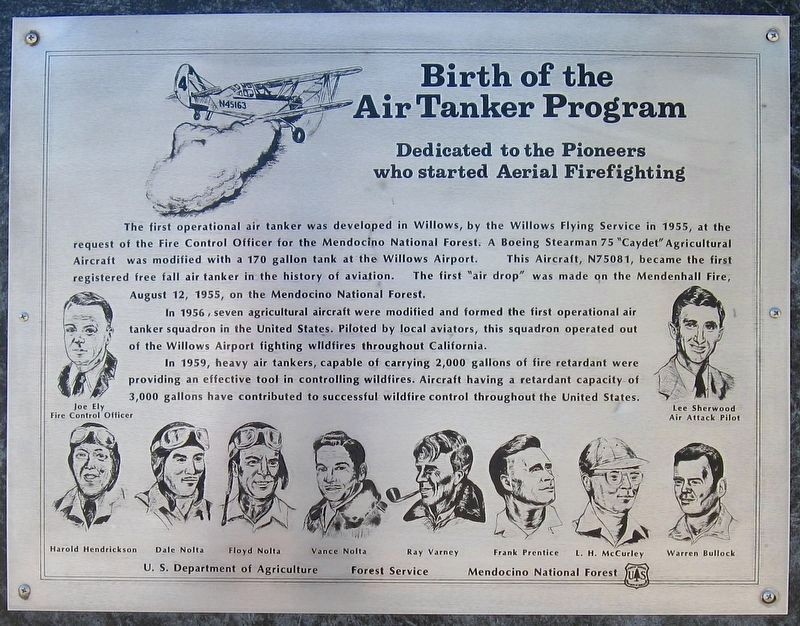
The marker at the Willows airport, put up by the U.S. Forest Service in 1981. It shows line portraits of Joe Ely, fire control officer; Lee Sherwood, air attack pilot; and the eight original pilots: Harold Hendrickson, Dale Nolta, Floyd Nolta, Vance Nolta, Ray Varney, Frank Prentice, L. H. McCurley, and Warren Bullock. We did not find a photograph of Sherwood or of the “bird dog” observation plane he flew.
View the marker page

Still to come
- Interviews
- Nothing posted yet.
- Stories
- Nothing posted yet.
Oral history
We want to record the story of the airport in the words of the people who lived it: longtime pilots and ag aviators, Nolta family members, relatives of the eight original air tanker pilots, veterans, and longtime residents. If you would like to be interviewed, or know someone who should be, get in touch.
Do you have something that belongs in the archive?
Email us a photo, clipping, or story